Trinity Physics
| | | | |
|
| |
Trinity Physics
| |
||
| | | |
||
| | | | | |
|
|||||
|
| |
|||
|
|||||
|
||||||||||||||||||||||||||||||||||||
| |
| | |
||||||||||||||||||||||||||||||||
|
||||||||||||||||||||||||||||||||||||
| | | | | | | | | | | | | | | | |
||||||||||||||||||||
| | | | | | | | | | | | | | | | |
||||||||||||||||||||
| |
| | | | | |
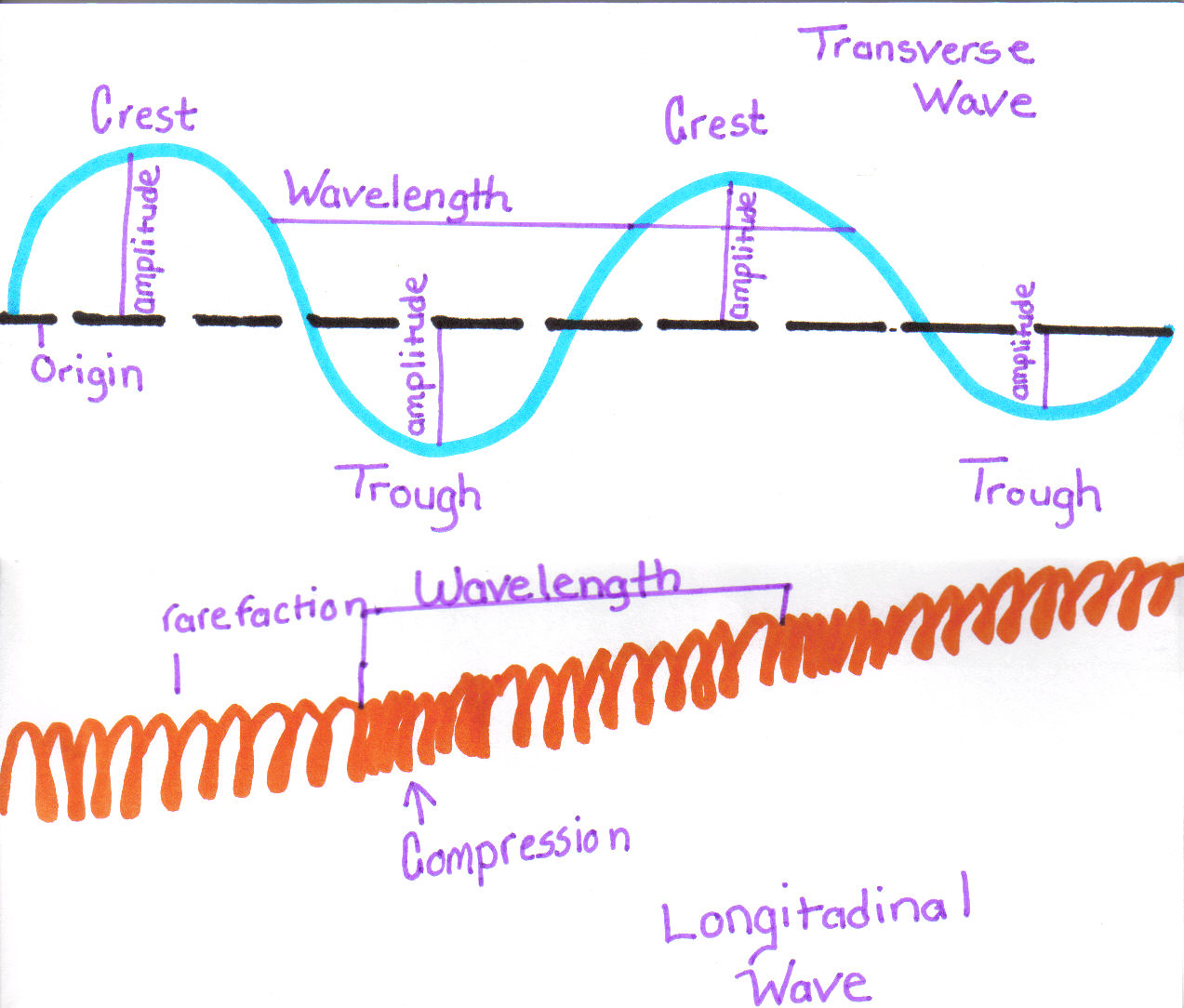
Understanding Waves You need to learn a few things about waves when starting out that prove to be very important when trying to work with them. You need to learn and understand a wave in different forms, as well as learn the parts of waves. We will start with measurements of waves. You can measure amplitude, period, and frequency when waves go by. Amplitude is the maximum displacement from the origin. The origin is where the wave would be if it was at rest. To measure the amplitude of a wave you measure from the origin to the crest, or from the origin to the trough. The crest and trough are the maximum distances the wave gets from the origin. If the wave were moving up and down the top would be the crest and the bottom would be the trough. You can see this in the diagram to the right. Amplitude is measure in meters. Period is the time it takes to execute a complete cycle of motion. Period can be measured from any point on a wave to the same point on the next one. It can be from crest to crest, trough to trough, or anywhere in between. This is also wavelength. Wavelength is the measurement from wave to wave in meters, while period is the measurement from wave to wave measured in seconds. Frequency is another measurement of waves. Frequency is the number of waves that pass through a point in a certain amount of time. Frequency is measured in hertz (Hz). You can use the equation f=1/T, where f is frequency and T is period, to find f or T. If a wave passed through a point in .5 sec, you could find frequency by putting .5sec, which is the period, in place of T. This leaves you with f= 1/.5sec or f= 2Hz. If you knew the frequency was 4Hz, you could substitute it in for f to find T. 4Hz= 1/T. The period would be .25sec. Measuring the T and f of a longitudinal wave is a little different. The compression (where density is the greatest) of the wave is like the crest of the transverse wave, while the rarefaction (where density of the wave is the least) is like the trough of the transverse wave. If you think like this you can do the problems the same. There are two types of waves, transverse, which is at the top in the diagram to the right, and longitudinal, bottom on the diagram on the right. A transverse wave is a wave whose particles move perpendicular to the wave motion. A longitudinal wave is a wave whose particles move parallel to the direction of wave motion. If just one wave travels through an object it is known as a pulse wave. If more than one wave passes through an object making a constant pulse a periodic wave is being produced. All longitudinal waves need a medium to travel through. A medium is just the material in which a wave travels through. A medium can be air, water, land, wood, metal, or any other object you can think of. What about transverse waves though? These waves do not always require a medium to travel through. Examples include visible light waves, radio waves, microwaves, and X rays. Waves that require a medium to travel through are known as mechanical waves. The waves that do not require a medium to travel through are known as electromagnetic waves. Electromagnetic waves can travel through a vacuum such as space. A sound wave is a mechanical wave and cannot travel through a vacuum. If mechanical waves traveled through a vacuum, we would be able to hear the sun explode. You can calculate the speed of a wave with the equation (speed of a wave= frequency * wavelength). (This site does not support symbols therefore they are not shown.) If the wavelength of a wave is 1 meter and the waves have a frequency of 500Hz, you can put these numbers in the equation to get a velocity of 500 m/s (meters per second). You can also solve for velocity with the equation (speed of the wave = wavelength divided by period). | | | | | |
 | | |
||||||||||||||||||||
| | | | | | | | | | | | | | | | |
||||||||||||||||||||
| | | | | | | | | | | | | | | | |
||||||||||||||||||||
|
||||||||||||||||||||||||||||||||||||
| | | |
|||||||||||||||||||||||||||||||||
|
||||||||||||||||||||||||||||||||||||